4.48 PSICOSIS – Sarah Kane
12 abril, 2006 Deja un comentario
La hora en que ocurre el suicidio
Luciano Cáceres dirige a Leonor Manso en el unipersonal «4.48 Psicosis»
Ver Nota
http://www.lanacion.com.ar/794929

GROSA
PVA: Opinología rellenadora de huecos o empatía al borde de un ataque de nervios
12 abril, 2006 Deja un comentario
La hora en que ocurre el suicidio
Luciano Cáceres dirige a Leonor Manso en el unipersonal «4.48 Psicosis»
Ver Nota
http://www.lanacion.com.ar/794929
GROSA
12 abril, 2006 Deja un comentario
Con Gladys Lizarazu
Blog
http://www.plazaatsensus.com.ar/sims_blog/?p=305
Alternativa Teatral
http://www.alternativateatral.com/ficha_persona.asp?codigo_persona=7869 
15 marzo, 2006 2 comentarios
Segunda muestra en cartel… del living de su casa. La compañía de teatro a domicilio Teatro a la Hora de los Postres festeja sus 140 funciones y renueva el repertorio, con la pieza Fueron perdices y comieron felices.
Se trata de un grupo de actores que brinda el servicio de animar fiestas particulares con una representación teatral cómica, de alrededor de 45 minutos. Ingresan al lugar por la puerta de atrás, se cambian y maquillan en el baño sin que nadie se entere, y de golpe irrumpen en la reunión.
El efecto se potencia si ningún invitado, ni el homenajeado, está enterado de que son actores. Después de la función, mientras se comentan los pasajes más divertidos, los mismos intérpretes sirven café, té y una torta casera de repostería escandinava. Más información:
15 marzo, 2006 Deja un comentario

A performance of much more recent vintage has inspired similar effusions among a certain subset of New York theatergoers. Mingling at an art opening or lounging in a club on the Lower East Side, some among you may have been subjected to a harangue, delivered through a smug fog of cigarette smoke, on the strange glory of Kate Valk in the Wooster Group’s acclaimed production of «The Emperor Jones,» in the latter days of the last century.
Alas for these downtown hipsters and their velvet ropes, this performance has not conveniently retreated into the V.I.P. room of theater legend, never to re-emerge. The Wooster Group production of «Emperor Jones» is back onstage at St. Ann’s Warehouse in Brooklyn, and there, at its center, is Ms. Valk again, riveting, haunting, altogether astonishing.
She is attired in tatterdemalion regalia befitting a legend-in-the-making, in a voluminous garment that resembles a cheapo king’s costume arrested in the process of swallowing a kimono. But the oddity of this ensemble may take a while to register, since the most arresting aspect of Ms. Valk’s aspect is the thick, oily black makeup covering her entire face. The petite, Caucasian, obviously female Ms. Valk is playing the title role, Brutus Jones, a venal black train porter turned despot, in O’Neill’s hypnotic play about the destructive impact of history on the shaping of personality. And she is playing it in blackface.
This choice might seem, on the surface, to be a culturally insensitive stunt designed to stir controversy, but it is fairly routine by the standards of the Wooster Group, the veteran theater troupe known for taking a playfully freakish approach to theatrical texts. Indeed in this case it could be argued that the decision to cast a white woman in a role written for a black man is uniquely sensitive. It’s hard to imagine a black actor playing the role today without causing discomfort, to himself or to the audience.
In the character of Brutus, the two-bit tyrant of a West Indian island who flees a native uprising and, lost in the woods, is gradually haunted to distraction and ultimately death by the ghosts of his own sins and those of American history, O’Neill was not drawing a damning portrait of a man, and certainly not prosecuting a race. «The Emperor Jones,» one of O’Neill’s first critical and commercial successes, was an expressionistic evisceration of the history that shaped Brutus Jones and bent his destiny, as it did that of too many black Americans, toward self-destruction.
But the language O’Neill used to create his ultimately compassionate portrait was inevitably influenced by contemporary cultural depictions of African-Americans (the play had its premiere in 1920), and it induces instant wincing today. In the opening scene, Brutus is roused from afternoon slumber by the whistle of a sleazy white businessman, Smithers (played with slime-dripping guile by Scott Shepherd, who alternates in the role with Ari Fliakos). He storms onstage and says: «Who dare whistle dat way in my palace? Who dare wake up de Emperor? I’ll get de hide frayled off some o’ you niggers sho!» So it goes for most of the play’s hourlong running time, since «The Emperor Jones» is virtually a monologue for the character of Brutus, who is onstage almost for its entirety.
Lest you assume that the blackfaced Ms. Valk is speaking a whitewashed version of the text, let it be known that she articulates every «dem» and every «sho» in an uncannily precise imitation of the singsongy vocal roulades of minstrelsy. The rummy baritone she employs for much of the time can also rise to a falsetto hoot, and the performance also features such potentially squirm-worthy effects as absurd, guttural laughs and rolls of the eyes suggesting childish fright.
But we remain, at all times, powerfully aware that we are witnessing an actress fashioning, with superb precision, a simulacrum of a stereotype. And this heightened awareness of Ms. Valk’s performance as an artificial construct shapes our perception of her character as a man spouting words and attitudes that destiny has forced him to emit. We see Brutus Jones himself as an actor helplessly playing a role written by the savage errors of American history.
The effect is enhanced by Ms. Valk’s choreographed manipulation of the microphone she uses, and the weird, hip-shaking soft shoe infused with Kabuki-like movements she performs with Mr. Shepherd between some scenes. These and other peculiar touches transform Brutus Jones into a flailing doll being yanked toward destruction by unseen hands. That Ms. Valk is somehow able to infuse this artfully outlandish performance with a poignant sense of entrapped humanity is remarkable. In fact it’s nothing short of sorcery.
But while Ms. Valk’s performance may evoke twinges of real pathos, don’t imagine that the Wooster Group and the production’s director, Elizabeth LeCompte, have suddenly gone sentimental. The company’s refractive approach to texts and its neo-Brechtian aesthetic are aimed at the intellect, not the gut, which may be one reason that Wooster Group productions can be more fully engaging when recollected in memory — or written about — than in performance.
There are, of course, pleasures to be derived from watching the company deploy with precision its ample arsenal of technical effects. «The Emperor Jones» is actually lighter on mechanized wizardry than many of the Wooster Group’s shows, but Jennifer Tipton’s burnishing lighting, Jim Clayburgh’s minimalist set, Christopher Kondek’s video and David Linton’s rhythmic synthesizer score create a typically elegant visual and aural backdrop for the performance. That this backdrop sometimes obscures or contradicts the specifics of O’Neill’s text will bother some more than others: Mr. Linton does not reproduce the accelerating, unceasing drumbeat O’Neill dictated, for example.
But Ms. LeCompte and her collaborators do not so much interpret texts as converse with them — even interrogate them. And if there are moments during a performance of «The Emperor Jones» when you feel left out of the conversation, and find your mind fixating with irritation on a particular peculiarity (why the darn fly swatters?), Ms. Valk’s entrancing presence is guaranteed to draw you back in. Playing a man falling prey to atavistic fear bred in his bones by centuries of history, Ms. Valk performs with a fearlessness that commands something akin to awe.
The Emperor Jones
By Eugene O’Neill; directed by Elizabeth LeCompte; music score by David Linton; video score, Christopher Kondek; sets by Jim Clayburgh; lighting by Jennifer Tipton; assistant director, Clay Hapaz; sound by John Collins and Geoff Abbas; video/master electrician, Gabe Maxson; video/stage assistant, Margaret Mann; stage manager, Teresa Hartmann; production manager, Bozkurt Karasu; technical director, Ruud van den Akker. Presented by the Wooster Group. At St. Ann’s Warehouse, 38 Water Street, at Dock Street, Brooklyn; (718) 254-8779. Through April 2. Running time: 1 hour.
WITH: Kate Valk (Brutus Jones), Ari Fliakos/Scott Shepherd (Smithers) and Scott Shepherd (Stage Assistant).
6 marzo, 2006 Deja un comentario
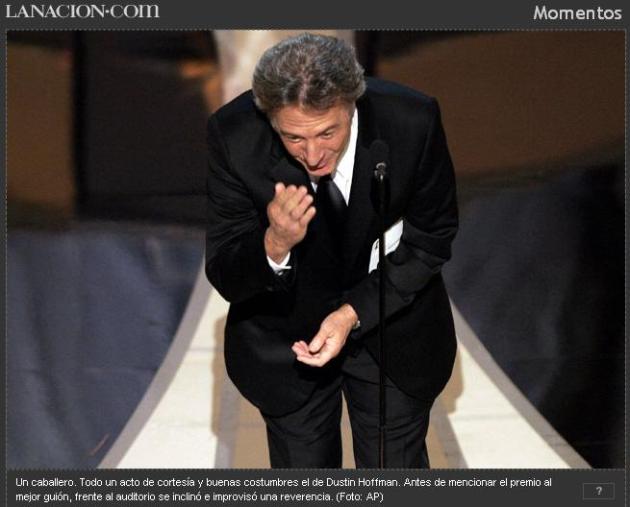
Un argentino para el Oscar
Foto La Nación

21 enero, 2006 Deja un comentario
Del guón de «Que he hecho yo para merecer esto?»
Escena en la cual la abuela con su nieto Toni de 14 años van a un parque de Madrid a buscar cosas…
Abuela: Toni, Toni… Toni
Toni: que abuela?
Abuela: ven corre
Toni: que
Abuela: Mira. Hoolaaa largarto; dile algo?
Toni: anda si el cabrón no se mueve; eso porque esta invernando abuela
Abuela: Huy probrecito que frió estara pasando…
Toni: que va, los lagartos estan acostumbrao
Abuela: No, en Madrid hace un frío que ni los lagartos
Venga, vamos a recogerlo. Me da una pena tener que dejar aqui al lagarto…
Toni: Y ya abuela pero….
Abuela: Mira!!! nos sigue
Toni: que
Abuela: nos lo llevamos?
Toni: que va abuela, la vieja no va a querer
Abuela: que nombre le pondremos?
Toni: Lagarto
Abuela: No, que lagarto es el bicho
Toni: LLámalo como algo que te guste
Abuela: a mi me gustan las madalenas, el cementerio, las bolsas de plástico, el dinero…
Toni: pues le llamaremos Dinero
Abuela: porqué?
Toni: porque es verde como los talegos.
21 diciembre, 2005 Deja un comentario






 Plaza At Sensus